Sunday, October 21, 2012

When the Summer Ends

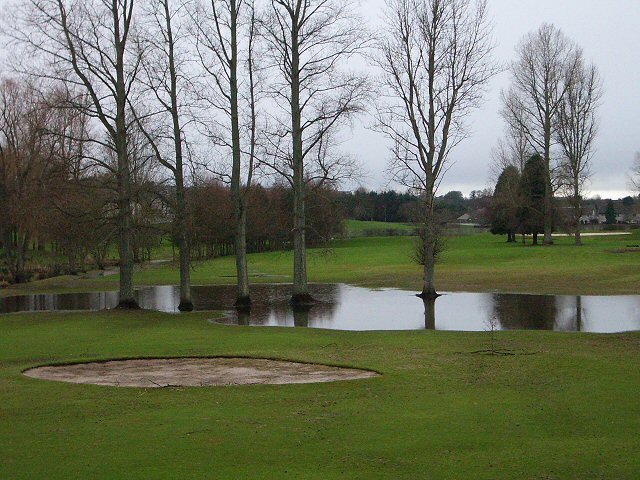
When the summer ends expect golf courses to be wetter than usual. This will ensure an accumulation of casual water on the course, soaking your balls and reducing their roll. Less roll equates to less distance, so consider some of the following suggestions.

Forget about longer distance chipping. Longer distance chips, otherwise bump-and-runs, rely on more extensive ball roll for the ball to reach the flag. In which case, on a water soaked course, your chip may not even make it to the green. Revert to pitching when required.

In much the same way the Texas Wedge putt will not be so effective either. In sunny Texas this could get you close to the hole from some distance, but when the rains left puddles it's usually best to leave the putter in the bag if you're off the green. Chipping is usually the better alternative. However, if you're still very close to the green it could still come off.

Select longer clubs than usual. For example, a chip that may require a sand wedge on a dry course could require something more like a 9-iron for the same distance on wet courses. In addition to this you should select longer irons on the fairway to provide some more roll for the ball.

If your ball lands in a puddle, otherwise casual water, remember that you do not have to leave the ball there. You can drop the ball out of the puddle without having to add a stroke. Just make sure that you drop the ball a little behind the puddle and not ahead of it. Never drop balls ahead of the original position.

On the green a little more pace will be required for your putts. Up the pace a little more than usual with firmer putting. But even on a wet green you can still over hit putts.

Wash your golf clubs when you can. They'll be more muddy than on dry courses, but can be rinsed down in deeper puddles on the courses. At the least you should rub your clubs down with a towel, or if nothing else your jumper to remove some of the mud from the club heads.

Those are just a few suggestions for wet golf courses. Check out this page for further details.

Wednesday, October 10, 2012

Great Public Golf Courses

You have to be a member to play at a private golf course. Such golf courses can have membership fees running into thousands of dollars, so for the casual golfer are not the best option. However, public golf courses do not require club membership to play on them, although they will likely still include membership packages. So, here are a few recommended public golf courses.

Pebble Beach Links

Pebble Beach Links is regarded as one of the best golf courses, and has hosted a number of top golf tournaments such as the US Open on five occasions. The best bit is that as a golf resort course it is open to the public, although admittedly has a high green fee approaching $300 dollars a round. Still, it is a great golf course that plays alongside the Pacific Ocean. Including some fantastic holes and setting, it can make for a great golfing vacation.

BethPage Statepark Black Course

Also featuring high on Golf Digest's top public golf courses is that of BethPage Black. This golf course played host to the 2009 US Open, and so is undoubtedly a tricky golf course. Although perhaps not ideal for beginner golfers, BethPage Black golf course is much more affordable than the likes of Pebble Beach with green fees ranging from $60 - $120.

The Ocean Course

The Ocean Course is the jewel in the crown of the Kiawah Island Golf resort. It is similar to Pebble Beach, in respect of its coastal setting, but is alongside the Atlantic shoreline. The course includes some great views of the Atlantic shoreline, although prevailing Atlantic winds can always impact a round at the Ocean Course. Notable golf tournaments such as the 1991 Ryder Cup have also been staged at the Ocean Course, as well as the World Cup of Golf.

Old Course at St Andrews

The Old Course of St Andrews is a great links course with a fine history. It is also a public venue for public golf, and so is recommended. The home of golf has played host to a number of UK Open tournaments, and has some great holes such as the road hole which is a long par 4, and the 11th par 3 hole. While the course is closed on Sundays, you can play it most other days providing there is no championships being played on it.

Kape Kidnappers

Kape Kidnapper's golf course in New Zealand is a golfing marvel. This golf course is a sea-side golf course, set alongside Hawke's Bay. Surrounding the golf course are 600ft cliffs that plunge into the sea, with some cliff-side greens for good measure. Course designer Tom Doak has said of Kape Kidnappers:

“Our goal in designing golf courses is to create interesting holes you wouldn't find anywhere else. That wasn't hard to do at Cape Kidnappers, because the site is not like anywhere else in golf.”

So overall, Kape Kidnappers is a spectacular public golf course and resort. The golf course has been ranked as one of the world's top golf courses by publications such as Golf Magazine. Admittedly, green fees are almost as steep as the cliffs at Kape Kidnappers, but it is a recommended public golf course.

So, these are five recommended public golf courses. The golf courses of Pebble Beach Links, Kape Kidnappers, St Andrews Old Course, BethPage Black, and the Ocean Course of Kiawah Island are all excellent public golf courses and resorts that have variable green fees.

Sunday, October 07, 2012

Red, White and Yellow Stakes

If you've played a few courses, you'll probably have noticed a few multi-colored stakes on some of their holes. These are usually wooden stakes, located around lakes, near to fences or other parts of a hole some way to the left or the right of the fairway. This is what the stakes are highlighting.

Red Stakes

The red stakes will be located alongside lateral water, such as a meandering stream, which may be running along the side of a hole. If your ball lands in one of these, then you've probably lost it if the stream is full of water. During the summer months streams might not be full of water, and you may still be able to find your ball to play out. However, if not then you'll have to drop you ball within a couple of club lengths behind one of the red stakes nearest to the point where you ball fell in the water.

White Stakes

White stakes are something else, and highlight those points of a golf course which are out of bounds. If you find that your ball has landed beyond a series of white stakes, possibly 25 yards apart, then it's gone out of bounds. In which case you'll have to pick your ball up, if you can find it, and go back to the approximate spot where you made the previous out-of-bound shot to drop ball. As a tip, you might want to leave a tee-marker at the original spot before searching for the ball if it may have gone out-of-bounds. Add an extra number to your scorecard and proceed.

Yellow Stakes 

Thirdly, there are also yellow stakes which will most likely be located around golf course lakes or smaller ponds. They're pretty similar to the red stakes, except that the lake or pond is not lateral. As such, if your ball lands in the water here you'll just have to drop the ball a little behind one of the yellow stakes closest to where you ball landed in the water. And of course, add a penalty stroke as well.

So, when on the course you should drop replacement balls close to these stakes if your ball goes in the water. Drop the balls a little behind them, no nearer to the hole where the ball originally landed. Or alternatively, return to the point where you made the original shot if the ball is out-of-bounds.


Wednesday, October 03, 2012

When the Golf Season Ends

November means the main golf season is all but over. However, that does not mean that all golf courses close, and so golfing can continue during the off-season. So, why not?

Certainly, the climate will drop a few degrees as winter sets in. But in certain parts of the US you can certainly expect mild climates to remain in those southern US states such as Florida, Arizona etc. Beyond winter, as spring emerges you can expect milder climates still before the golf season really begins.

However, playing golf in colder weather may still require warmer clothing. A good golf jumper should be okay. In addition to this, vests, gloves, and woolly hats are recommended. In addition to this, a Thermos flask with tea or cocoa will also be worth taking onto the golf course.

You can also expect that golf course conditions will likely be wetter. That is to say, with annual precipitation greater beyond summer and during the winter months. If the weather is colder still, frost can also make golf courses damp. Damp golf courses will mean that the ball will not roll as far, and so in this respect less distance. For putting, putts can be under-hit and missed on damp greens.

The chances of downpours may also be greater off-season. In this respect, if it starts to rain heavily you might have to abandon the course. Take an umbrella out on the golf course, and do not play if overhead clouds are very grey.

Despite this, there are a few advantages to playing golf during the off-season. Some golf courses may reduce rates during the off-peak periods. As such, off-season golf can be more economical.

During the off-season golf courses you can expect the golf courses to be more empty. Emptier golf courses means that you can play round the course more quickly. Alternatively, quite the opposite if no golfers are behind you can take your time. Overall, golf courses will be easier to get on to with no advance book that may be required during the summer.

Still, if you must not play on a golf course during the off-season, then ranges are a better alternative. Whether it's pouring or not, golf ranges will be open. As such, this can be the next best thing to playing on course.

So, playing golf in the off-season has its advantages and disadvantages. For sure, weather conditions can vary, and golf courses will certainly be wetter during the off-season. However, during the early spring you can expect more sunshine, and potential discounts during the off-season

Wednesday, September 26, 2012

Best Golf Courses Video

Which are the best golf courses? This video includes a great compilation of "some of the world's best golf courses." Check it out! 


Sunday, September 23, 2012

Great Mackenzie Golf Courses

Mackenzie was a great course architect who inspired some famous golf courses in the early 20th century. Mackenzie's golf courses in the United States stretch from Georgia in the east, to California in the west. These are a few of Mackenzie's great golf courses.  

One of the holes at the Augusta National.
Augusta is one of the most famous golf courses in the game. Located in Georgia, this is one you've probably heard of as the annual Master's golf championship is played here. It's the only course that has its own Major, and extends some 7,445 yards. I've also included course video tours in previous blog posts.

Around its famous holes the course has a compilation of plants among its flower beds, and pine trees which run alongside some of the fairways. In addition to this, the course has water on some of its more exciting holes, such as the 12th Rae's Creek where a creek separates the green from the tee-box. For further details, check out this previous blog post.

Cypress Point, in California, is another great Mackenzie course. Both Golf Magazine and Golf Digest have ranked this among the top five golf courses in the United States. It has a fantastic coastal setting, as it meanders through coastal dunes and also passes through the Del Monte forest over the front nine. The 16th 231 yard par-3 hole is one of the most exciting par-3 holes you'll likely find on a course with a tee-shot required over the Pacific to make the green. This previous blog post includes a Cypress Point video tour.

The Royal Melbourne and the Crystal Downs Country Club are two other notable Mackenzie courses. The Royal Melbourne is located in Australia, and its composite course, which includes holes from both the East and West courses, is one of the top rated courses beyond the United States. Mackenzie primarily inspired the West course when he visited Australia during the 1920s. The Crystal Downs Country Club is a 6,518 yard course that plays alongside Lake Michigan and Crystal Lake, and this too has made the top 10 of Golf Digest's course rankings.  

These courses are ranked among the best in the world. Few course architects have courses which match these classic Mackenzie golf courses.  

Wednesday, September 19, 2012

Merion Golf Course

Today I've dug up another golf course tour video. This time, it's the Merion East Course in Pennsylvania. This is a 6,846 yard golf course that has hosted four U.S. Open  Championships. The next U.S. Open will also be played at this course as well. Check out the video below.


Sunday, September 16, 2012

Golf Club Selection for Longer Grass

A Pebble Beach green surrounded
by longer grass
Around the fairways and greens there is longer grass on the golf course, otherwise the rough. When your ball lands in the longer grass, effective golf club selection will go some way to ensuring that your ball will fly out of it. Here are a few suggestions to note.

When selecting a club for longer grass, clubs that have more loft will be most effective in playing out of it. Certainly, if you are in longer grass very close to the green, the wedges should come into play. With either a sand or pitching wedge you should be able to chip your way out of longer grass and onto the green.

Some may be familiar with the bump-and-run chip, which is essentially a longer distance chip which rolls onto the green. Don't play any longer distance chips from around the green if you are in longer grass, and cannot expect the ball to land on the green first. The longer grass will take most of the roll off the chip, considerably reducing the distance. Instead, select a wedge for a pitch onto the green.

What if your ball is in longer grass closer to the tee-box? A lofted wood can be a good choice of club, as it will also provide some distance as well. Consider a club such as the 7-wood, which can have up to 20 degrees of loft. Short iron clubs such as the 9 and 8-iron are also good for playing out of longer grass along the fairway.

But, if you're in very long grass you should select a wedge, such as a the sand or pitch wedge, wherever you are on the hole. Select a wedge for a pitch out of the grass, to get the ball back onto the fairway. This may reduce distance but it will also reduce the possibility of the ball remaining in the longer grass.

So, any of the wedges, 7 or 9-wood, or the 8 and 9-irons should be suitable clubs to select when in longer grass. Make sure you have a few of them in your bag for a range of suitable clubs for the longer grass.

Wednesday, September 12, 2012

Brief Guide to Short Play

In the game of golf the short play refers to shorter distance shots such as putting, chipping, and pitching or bunker play. This can be either on the putting green, or alternatively around the green up to 50 yard or possibly 75 yards.

On the putting green, though you might never have guessed it, the putter is used! From here, a longer lag putt may be required to set-up a shorter putt for the hole. For example, if further than 10 or 12 yards from the hole then you will likely need a lag putt. Then a shorter putt of about three feet may only be needed.

The greens can be variable. Some might be flat, while others may include slopes. For these, you need to be careful and take into account that a putt will not go so far up a sloped green. Equally, a ball will roll further on a dry green than a wet green.

It should be noted, that even if you are not on the green, then putters can still be used to putt the ball onto one. If you are close enough, and on reasonably short grass, then a putt onto the green from the fairway can be effective.

Of course, in the event that you are slightly further from the green then a putter may not be suitable. In such cases, balls can be chipped onto the green from variable distances up to 50 yards or possibly even further with enough ball roll. Realistically, it is best to chip from within 50 yards with an iron club such as seven, eight or nine. Alternatively, for short chips then a sand or pitching wedge can also be suitable.

However, the chip shot does have its limitations. Let us say, for example, that you are in the rough grass with a fairly large bunker in front. Here, a chip would not clear the bunker so a pitch shot would be a better alternative. The pitch shot is short lofted shot that can clear bunkers or even water.

The actual distance of pitching can vary. Usually, they can be within 50 yards of the green, or possibly further away for longer pitches. In such cases that only a short shot is needed to land on the green, then pitches are also suitable.

Only the wedge clubs are really suitable for pitches. Clubs such as the sand wedge or pitching wedge have a good amount of loft. Other longer irons will not have the loft required.

Bunker play from green-side bunkers, can also be considered short play. If a ball lands in a bunker, then a bunker shot from out of the sand and onto the green is best. Overall, the sand wedge is the club for bunker play from greenside bunkers.

Overall, putting on the green is the most important part of short play. However, chipping, pitching or bunker play will also likely be required on most holes from around the green.

Sunday, September 09, 2012

Parque Da Floresta course video

Today we're heading to the south of sunny Spain with this golf course tour video. To the Parque Da Floresta course in the Western Algarve! This is supposed to be one of the best in Spain, set alongside the rolling hills and golden beaches of the Lagao it is an 18 hole course to note. Check out the course tour video below.


Wednesday, September 05, 2012

Don't Forget the Yardage Chart

The yardage chart is one of the handiest things to have for a round. Yardage charts are those hole-by-hole sketches of golf courses, which include details of the relative hole yardages at various points on the hole. They can highlight yardages from various points off the green, not merely the tee to green yardage of the hole that's noted on the main scorecard anyway.

A lot of course scorecards include small course yardage charts on the back of them. Note that you can note down additional yardage points onto them with a ruler and calculator if they lack details. Multiply the yardage total by percentages, and then note their relative yardage position on the hole yardage chart. For example, the half yardage of the hole would be 0.5 x total yardage.

However, some golf clubs may also have larger, more detailed, mini-booklets which provide details for the hole yardages, and will also highlight the relative positions of the bunkers, ponds etc more closely. If so, add the mini-booklet to your bag. They can provide much more detail than what might be included on the back of a scorecard.

Either way, you should have some sort of yardage chart for the round. Especially if you are unfamiliar with the course and its layout.

A more detailed hole yardage chart
which highlights a variety of yardages. 

Sunday, September 02, 2012

New Book

My new book, which has absolutely nothing to do with golf, is out now. Battles of the Pacific War 1941 - 1945 can be found at both Amazon and Lulu, in Kindle and paperback format. For further details, check out this blog.

Wednesday, August 29, 2012

Arcadia Bluffs Golf Course Tour

Arcadia Bluffs is a course located in Michigan. Undoubtedly, this is a modern golf course which was opened in the late '90s. This golf course is located on bluffs above the shores of Lake Michigan. As such, this is a golf course which has plenty of lake frontage and elevation. The course has been included in Golf Digest's top 50 U.S. public golf courses, and if you can reach it is certainly worth noting. Below is an Arcadia Bluffs video tour.


Sunday, August 26, 2012

Golf Courses in Sugarland, Texas

Texas, the US State that is home to cowboys, cattle ranchers and golf courses! Sugarland, Texas, has five golf clubs, with nine golf courses, which should provide enough to satisfy most golfers of various levels. There are a number of courses a few miles further afield, but these are the courses exactly within the Sugarland area.

Let us first look at the public Greatwood Golf Club. It is an 18 hole regulation golf course of approx. 6,836 yards in length. With four tee boxes it can cater for a diverse group of golfers, and has green fees ranging from $28-$55 dollars. Being an open to all course, it is one that really should be sought out by all golfers in the Sugarland area.

The Riverbend Country Club is a private club, with a private course. Still, if that is what you want the course will provide an 18 hole par 72, with a yardage of about 6,600 yards. The eigth hole is especially tricky, with water from the tee to the green. Green fees are up to about $65 dollars.

If it's a nine-hole course you want, then you really should pay a visit to the Sugar Creek Country Club. For the club has three nine-hole courses for you to take on! The Trent Course, Robert Course and the Jones Course all provide 36 par, nine-hole courses between 3,100- 3,400 yards in length. The slope rating of these courses is not yet clearly specified.

Sweetwater Country Club has two 18 hole golf courses, which makes for a 36 hole golf club. The Pecan Course has the highest of slope ratings of the aforementioned courses, with a 74 course rating. It has a championship layout, but with four tees can provide a suitable course for other golfers. An 18 hole, par 72 it boasts a yardage of 7,145, making it the largest in the area.

And the second course at the same club is the Cypress Course. This has 18 holes and a par of 71. With a course rating of 72.6, it is the easier of the two courses. Likewise, it also has a smaller yardage of 6,728. Further more, it is the cheaper of the two courses available at the Sweetwater Country Club.

So, golf in Sugarland is catered for with largely private clubs with courses of variable length. From 3,200 yard nine-hole courses, to 7,145 yard 18 hole championship courses. Most of them have variable tee boxes, however, allowing for the selection of different starting positions to make the distance more or less. As such, the courses in Sugarland offer flexibility and value to golfers. How sweet!

Wednesday, August 22, 2012

Pine Valley Golf Course Tour

Pine Valley is one of the more famous U.S. golf courses. Even though it has not hosted many big golf championships, it has remained among the highest ranked golf courses in the states. The course is approximately 7,000 yards long, and has a great collection of par-5 holes and big bunkers which align the fairways and greens. Below I have included a simulated tour of the Pine Valley course.

Sunday, August 19, 2012

Team Golf

Most of the golf championships may be singles, but there is such a thing as team based golf. The Ryder Cup is one such example in which the U.S. and EU teams play for the Ryder Cup trophy. This is a match-play championships, but there are various formats for team golf rounds. With a group of four these team golf scoring formats are worth noting.

For example, there is best ball. This is actually quite simple, each player finishes a hole, and then each team records their best single score for the hole. Best ball becomes Four Ball with the match-play format. Then the team with the lowest score for the hole wins the hole.

Scramble is another alternative. With scramble everybody tees off, but then only one spot where the team's balls have landed is selected for the next. The others pick up their balls, and then play from within one club length of their team's selected ball. Then it's the same again until both teams have holed out.

Those are two of the more widespread team scoring formats for championships, but you can always set up your own customized team formats for your own rounds. For example, why not consider combining everybody's scoring for a single hole? As such, in doubles two scores would be added for each team. That's one way, or you could take it in turns to play through holes instead so that only one from a team plays a hole. This would be a quicker team golf format than some of the others.

So overall, there's a few team golf formats. Best ball is probably the most straightforward, and in that respect is the format of choice for many.

Wednesday, August 15, 2012

Video Golf Course Tours

Where can you find video tours of famous golf courses? Well, you can at Amateur Golfer. Here are the links to eight of the previous golf course tour posts on this blog:
Stay posted, as their could be more to come!

Sunday, August 12, 2012

Bethpage Course Tour

Bethpage Black Golf Course, at Long Island, is one of the few public courses which has hosted the U.S. Open. This is a renowned championship golf course which is some 7, 468 yards. Check out the latest addition to AG's golf course tours, the Bethpage Black video. 


Wednesday, August 08, 2012

Brief Guide to Golf Clubs

On the golf course, you can use up to 14 clubs. Any variety of clubs is allowed here, giving golfers some scope for selection. There are a few different types of club that golfers can select from.
The Woods
The Woods are clubs that can be used off the fairway and the tee. From the 1 wood to the 7 wood, they can have slightly variable design. As with other clubs, the lower numbered woods are the longest clubs used for the longest shots off the tee with most distance, which can be between 300-400 yards. Higher numbered woods can be used in longer grass, or off the fairway with greater loft. Equally, the lower numbered woods have the least loft. Generally, they have graphite or steel shafts and some have titanium club heads.
The Irons
The irons are the most flexible clubs. They can be used off the fairway the tee or even for shorter play with chip shots. Ranging from the two irons to the nine irons, there are longer and shorter irons for selection. Considering the range, the two, three and four are longer distance; with the five, six or seven irons more 100-175 yards and then the eight or nine irons the shortest irons for distance. The overall loft is also lowest for the two iron and then increases towards the nine iron. For short play, you can also use the irons like the nine, eight and seven for chip shots onto the green.
The Wedges
The wedges, are those clubs with the greatest loft, not usually used off the tee but available for short play. The sand wedge is a club used for bunker play and bunker shots from greenside or fairway bunkers. This is one of the most lofted wedges available. These clubs are also best used for pitch shots, which require greater loft and little roll. They can also be used for shorter chip shots onto the green.
The Putter
The putter is a club that is used for short play and putts on the green. Overall, this covers a good number of shots and is most often used for one or more putts on the green. However, it can also be used to putt onto the green. Putter designs can actually be quite variable, but like all clubs must be accepted for the market.
Overall, these golf clubs make a standard set of 14. Usually, seven or eight golf clubs will do. With multiple irons, woods then a few wedges and a putter to complete the set. While golf club design can vary, they must be approved beforehand.

Sunday, August 05, 2012

Top 10 Best Golf Courses in the United States

I know I've included similar top 10 lists before, but those were just lists! Now I've found a classy video of 10 of the best courses in the United States. Check it out below.